Confirm the actual service context
Use the official address lookup and current operator record to establish the supplier. Black Mountain Irrigation District publishes dated water information relevant to its actual service area; do not assume every property carrying a Black Mountain location label has an identical connection. Keep the provider result and report period separate from building-side symptoms.
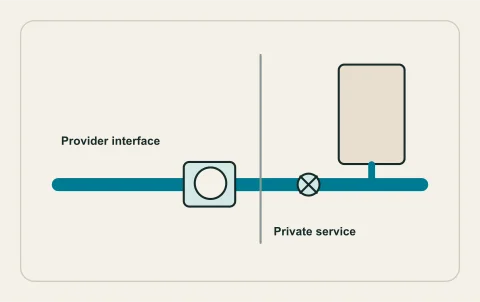
Confirm the governing building authority as another question. Postal names, views and a supplier relationship do not define every municipal boundary. Record whether the property is a single dwelling, shared building or another arrangement, because authorization and shutdown planning depend on it. A useful brief describes the actual service and proposed work without inventing a universal pressure, source quality or pipe material for the hillside area.
Read BMID’s dated water reports only for the confirmed service context.
Treat pressure as a measured system question
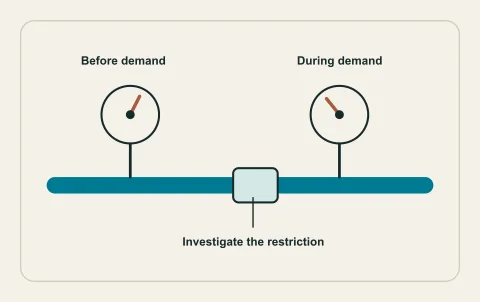
Describe whether the symptom affects one fixture or the whole building, whether it changes with use and whether the operator knows of an event. A hillside address does not by itself prove the need for a booster or a particular regulator adjustment. Ask the qualified professional what measurements and system information are needed to establish the relevant cause.
Do not alter unfamiliar pressure equipment or operate public valves as a homeowner test. Elevation can be part of a professional assessment without supplying a generic design answer. Keep the measured finding, examined segment and limitations visible. A device recommendation should explain how it fits the actual service and building, not rely on a blanket claim that every property in the area needs the same equipment.
Investigate buried access and route constraints
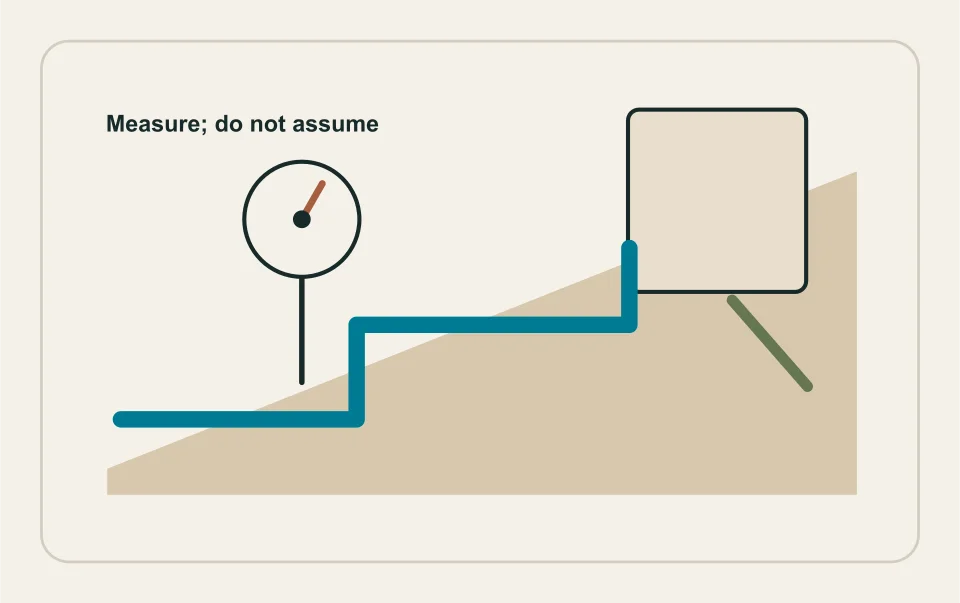
Sloping or constrained sites can require particular attention to safe access, structures and other services, but their actual conditions must be assessed. Ask who obtains records, locating and further investigation for unverified private infrastructure. An owner sketch can identify visible features without becoming a surveyed route or excavation plan. Do not infer pipe depth or grade from the terrain visible above it.
Compare connection openings, equipment access, spoil handling and reinstatement. A trenchless method still needs suitable geometry and access; a short method label cannot guarantee feasibility. Record what evidence could change the method and how additional work is authorized. Professional design and the relevant authority determine required installation details for the actual route and public interface.
Where access involves retaining structures or a confined equipment route, ask which person assesses that interface and how their finding affects the plumbing method. A contractor can describe access limitations without certifying unrelated structures. Record any dependency and the scope of the assessment needed before work. Likewise, provider information should retain its sampling period and service area rather than become a claim about an individual fixture. Keeping structural, service and private-system evidence separately labelled makes the project easier to compare and prevents one plausible hillside explanation from suppressing another cause that remains unexamined.
Check site-specific development questions
If work affects grading, retaining structures, environmental features or another site condition, ask the actual authority what review applies to the parcel and proposal. A broad hillside guide cannot determine a development permit area or authorize excavation. Keep current maps, existing approvals and the qualified designer’s information together so constraints are addressed before the construction method is accepted.
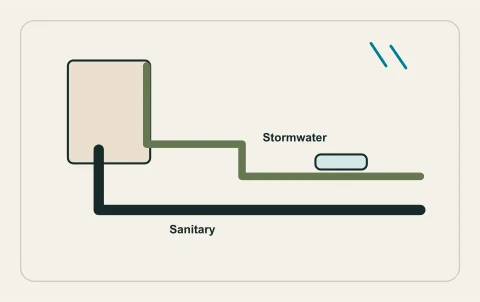
Drainage alterations also need a confirmed discharge and system distinction. Roof runoff, sanitary wastewater and foundation drainage are not interchangeable routes. Ask which component is being investigated and what evidence establishes the outlet. A repair addressing one private line should not be sold as solving every runoff or slope condition that was never within the agreed scope.
The City environmental development permit entry point frames a parcel-specific review enquiry, not a universal hillside classification.
Retain performance and site evidence
The handover should identify the investigated system, actual changed segment, relevant measurements or checks and approval records. Preserve original recordings or useful photographs where included, with dates and limitations. A new component does not prove every hidden branch or site condition sound. Record remaining symptoms, retained older sections and any required follow-up.
Restoration of surfaces, landscaping and building finishes may be separate from pipe installation. Assign those duties clearly and retain restrictions until the appropriate people complete them. If the symptom recurs, compare the actual pattern with the previous finding rather than assume terrain is the cause. A property-specific record allows later professionals to assess service, pressure, route and site questions independently instead of inheriting a neighbourhood stereotype.
Prepare a hillside-area request
Prepare a hillside brief that identifies the actual supplier, property authority and observed system pattern. State which pressure or route information is measured and which remains an assumption. Describe visible equipment-access constraints without declaring a concealed grade or structural condition. Include relevant site records and identify the professional role needed for any retaining, development or other interface outside ordinary pipe work.
Ask the provider to connect the proposed equipment or construction method to the actual evidence. Compare access openings, connection work, checks and reinstatement alongside installation. Keep operator reports dated and limited to their service scope. The handover should preserve measurements, changed segments, approvals and remaining restrictions. A later complaint can then be assessed against the original finding without attributing every event to elevation or assuming a new component renewed all hidden branches.
Use the request form for a person to review and reply about planning. This reference service does not provide engineering dimensions, a booster specification or a guaranteed local booking, and it promises no response time. Active hazards need the appropriate urgent service before the review. After control, a clearly limited brief helps organize site and plumbing responsibilities while leaving design, permission and physical work with the actual qualified professionals and responsible authorities.
Questions people ask
Does elevation prove a booster is needed?
Does Black Mountain identify the provider automatically?
Can surface slope establish buried pipe grade?
Is trenchless work guaranteed on a constrained site?
What should the site handover preserve?
Sources and further reading
- Find your water provider ↗ · City of Kelowna. Checked 2026-10-02.
- Monthly & yearly reports ↗ · Black Mountain Irrigation District. Checked 2026-10-02.
- Environmental development permits ↗ · City of Kelowna. Checked 2026-10-02.
- Plumbing & heating permits ↗ · City of Kelowna. Checked 2026-10-02.
- Permit inspections & area map ↗ · City of Kelowna. Checked 2026-10-02.
Confirm the current requirements with the responsible authority for the actual address and work. This reference does not replace site assessment or an official decision.